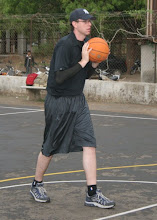
I had this conversation about 10 times before I left.
“So, JD. Where are you going next?”
me: “Mizoram (AHM)”
“wheere? “
me: “Mizor (AHM)”
“wheere?”
me: “Mizor(ahm) – Northeast India – near Assam and Bangladesh, one of the seven sisters, you need a special visa for tourists – Mizoram” …
“Oh…Mizoram (IM) … you mean MizorIMMMM….
Its very, very beautiful there! “
Me: “Really, have you been there?”
“No, no. I have never been there exactly, but I am sure it is very, very beautiful and amazing. It is safe now, only. You are lucky! What are you doing there?”
Me: “Basketball”
“Why? Do they play basketball there? A lot of mountains and goats.”
Me: “I guess I am going to find out!” (Goats????)
I first met KC when I conducted a program at Sports Authority of India (For US Department of State), NSINIS in Patiella where he was studying to become a basketball coach. Thanks to the facebookization of India, he continually kept asking for me to visit his city. As life happens, I bumped into KC and his Mizoram gang at the Jr. National Championships in Vashi, New Mumbai. I had time between programs in New Delhi so I packed and got ready for the adventure.
I was the first foreigner coach Mizoram Basketball Association ever invited.
After a 10-hour trip from Delhi to Calcutta to Aziwal (with a stop in Assam, remind me to blog on the old Delhi domestic India Air airport on another day – if you can AVOID the 7am flight out of this terminal- DO IT!) I was greeted at the airport with smiles and red roses. We went to register at the visitor booth and at security departure and off we embarked on the 50km route thru the ‘Blue Mountain” to Arizawl.
Large mountains consumed the backdrops and primitive bamboo homes were the in front. I saw little arms and legs draped outside wrapped blankets on the backs of the women as they worked. Young children were playing off the highway — it worried me they were in harms way. I kept thinking, where am I?
The mountains were truly breathtaking and it was refreshing to see there no Ashrams, or westerns walking around in maroon robes, no 7 star Oberois, no McDonalds, and no Thomas Friedman’s — there world here is still ROUND and I suspect remain unchanged for a long time. I kept thinking where am I ?
During the drive, host Charla was singing the Beatles “long and windy road” when Mala’s cell phone would ring (that like every 2 minutes) ring tone Kanye West “stronger” as we rode the windy roads. I kept thinking where am I?
The topography changed distinctly as I entered into the city limits.
Aizwal, Mizarom reminds me of Srinagar, Kashmir — a bit Swiss Family Robinesque; a city nestled in the mountains. All of the homes were built are vertical into the mountainside.
I had seen the Dhala Lama the week before and naive to Northeast India, and had grandiose visions of stumbling into some Buddhist Monks hooping in some sacred grounds (and me calling ‘next’.) Interestingly enough though, 95% of the people in Mizoram are Christian. Christian bookstores and churches were in every 360-degree view.
The Mizos (Mi= People, Zo= Hill) do not speak Hindi- just Mizo and English and its not Bollywood films they enjoy — it’s Korean!
Mizoram is very different than any I have traveled to in India. I saw no one dressed in kurta, very few Hindu statues or banners with politician’s faces. Very Few cars honked as they sat in traffic. It is the # 2 most literate state in India and a dry state. The Mizos have an Asian type look and are very up to date with American fashion and music.
According to WIKIPEDIA:
The origin of the Mizos, like those of many other tribes in the northeastern India, is shrouded in mystery. The generally accepted view is that they are of Mongol descents and were part of a great wave of migration from China and later moved out to India to their present habitat. It is possible that the Mizos came from Sinlung or Chhinlungsan located on the banks of the Yalung River in China, first settled in the Shan State and moved on in the middle of the 16th century to Kabaw Valley, Khampat, Tahan and the Chin Hills. The earliest Mizos who migrated to India were known as Kukis. Mizo history in the 18th and 19th century.
As we started to drive into town, what I saw amazed me… Kids dribbling basketballs up a huge hill. Hmm, wow must be a fluke – 8 separate instances – ball in hand. Kids rocking Boston Celtics Book bags, Celtic sweatshirts, Celtics hats 0 — wow the ghost of red Aurbach? Who could have predicted a traffic jam taking over in hour in such a small town?
Learn a new culture! BTW they eat dogs and fried frogs here as a delicacy (no I did not try….) A lot of hilly walks, the traffic is so bad here – best to take a two wheeler – um, down THAT hill? The shower had hot water for like 18 seconds (and it took me two days to figure out how to get it started) but after the Westerness rubbed off I realized — this place is AMAZING! India always brings me back to a sense of humanness.
After a short respite in a modest hotel – with amazing chai (some of the best in India!) We hit to the courts.
What I found was what the Mizos lacked in height, they gained in endurance and speed. There basketball were worn, there shoes were worn – these guys loved to play! Unlike all my India stops, I can see from the initial ball handling drills they have seen them all before and the have been practicing.
One guy even wore a St. Mary’s practice jersey – at St. John the Baptist they were in our league and we hated them – how on earth did he get that?
For a coach it’s exciting to watch new players work so hard, I watched them go thru the sessions, learning smiling but taking the game very serious. We conducted four days of training/ promotion here. Most of the training was completed large group skill work – and 2 classes just for coaches. Each day we got up about 200 shots, and worked on important fundamentals such as jump stop, pivoting and balance. By the end, we had put in a triangle type offense and a few new plays. I trained the coaches on what to look for, how to explain certain drills and we had long talks on basketball philosophy and India basketball. I was happy with the improvement – -I think the Mizo coaches were too!
As most teams run none here in India, we did a Skype call with legendary NBA head coach, Don Casey – who gets big kudos for an early AM San Diego wake time. Besides being a great teacher – he loves the game.
One of the most memorable parts of the program was on the last evening, the Mizoram basketball Association held an entertainment night. Three Mizo celebrities (Mami Varte, Mimi Renthlei and Michael M Sailo -5 year old boy!) came out and sang and rapped for us and about 250 school children. That was fun.
I was touched as all the guys drove me out to the airport, and was intrigued to hear they guys talk about the political/social/economic relationship between Mizoram and India.
The Mizo code of ethics or dharma focused on “Tlawmngaihna“, an untranslatable term meaning that it was the obligation of all members of society to be hospitable, kind, unselfish, and helpful to others. Tlawmngaihna to a Mizo stands for that compelling moral force which finds expression in self-sacrifice for the service of others. The old belief, Pathian, is still used to mean God. Mizos often gather together to help in disaster management like landslides or famine. – http://en.wikipedia.org/wiki/Mizoram
My guests were the true example of TLAWMNGAIHNA!
THANK YOU!
Chalroranga (Charlo), Malssuimzuala (Mala), K.C. Lallianthuango (KC), H. Laldinsanga (Marvin), Lalruatfela (Arfela), Big Guy, & Lalrina Renthlei
Thursday, November 18, 2010

Monday, April 5, 2010
jdBASKETBALL and George Mason Return to India to with Raise Cultural Awareness through Basketball
FOR IMMEDIATE RELEASE
April 5, 2010
jdBASKETBALL and George Mason Return to India to with Raise Cultural Awareness through Basketball
MUMBAI, India, April 5, 2010—Three American coaches, including two George Mason University faculty members are returning to India as part of a U.S. Department of State Sports Initiative grant and cultural exchange program. Aimed at developing awareness of basketball in the country, JD Walsh, founder, jdBASKETBALL, Robert Baker, associate professor of sport management, and Craig Esherick, assistant professor of sport management, will hold combined coaching clinics and youth basketball camps throughout India. The trip is funded by an International Sports Initiative grant.
The grant, awarded through the SportsUnited Division of the U.S. Department of State’s Bureau of Educational and Cultural Affairs, will fund a multi-part plan meant to provide a formative experience in the lives of participating Indian boys and girls. During this trip clinics and camps will be held in Chennai (April 7-10) with Sports Development Authority of Tamil Nadu and Bangalore (April 11-14) with Basketball Federation of India Men’s Senior National Team. Walsh, Baker and Esherick will provide direct instruction, cross-cultural exchanges and hands-on experiences for players, coaches and league administrators that will not only enhance skill development, but also broaden participants’ understanding of diverse cultures.
“The fact that the State Department has a program for grants to use sport on an international cultural exchange and development basis is recognition of sport as a cultural connection,” says Baker, who is also the director of Mason’s Center for Sport Management. “Our intent is to take the best practices of basketball leadership in the U.S. to India.”
Baker and Esherick have partnered with J.D. Walsh, a former college basketball player and coach who is also the founder of jdBASKETBALL. Having worked extensively in China and India, Walsh has traveled throughout India in the last three years teaching basketball, operating clinics and developing the sport. “Basketball has a unique way of connecting people together. I feel the game resonates with everyday beat of India and dance. Learning about the Indian people and exposure into the Indian heart has become my life’s work, and I am happy to be part of this program to expose more to this program.
During the clinics, the trio will teach fundamental basketball skills to Indian youth while simultaneously exposing them to American culture through the basketball experience. Coaches and administrators will learn how to run and market successful basketball leagues and clinics in India while coaches are also taught various instruction methods. The exciting tour will hilite the trio working with ndia’s Men’s Senior National Team in Bangalore and Head Coach Alexander Bucan.
“Basketball has become wildly popular all over the globe,” says Esherick, who was an assistant coach and scout for the 1988 U.S. Olympic basketball team. “We have a chance to help popularize basketball in a country that has not yet wrapped its arms around this sport. Our trip is also a great opportunity to exchange ideas about coaching all sports as well as to discuss best practices in sport management.”
Baker, Esherick and Walsh visited India in Nov. 2009, as the first part of the International Sports Initiative grant, holding clinics and camps in New Delhi and Kolkata. In New Delhi they were hosted by the New Delhi YMCA while in Kolkata the West Bengal Basketball Association hosted the trio. This time the group will be working with the Sports Development Authority of Tamil Nadu while in Chennai. In Bangalore, they will work with the Basketball Federation of India, the National Team of India, the National Basketball Coach of India and various local schools and clubs.
While in New Delhi previously, the group was pleased to receive a visit from U.S. Ambassador to India, Timothy Roemer. Ambassador Roemer, whose children had participated in a clinic run by Walsh, played basketball with clinic participants and spoke to coaches and youth attending the clinic.
Baker, Esherick and Walsh have also identified 10 sports leaders to travel to the United States in summer 2010 to attend a Coaching Academy at Mason. During their time in Virginia, Indian coaches and administrators will receive instruction in sport management, participate in extensive interactive exchange with American sport officials and undertake an opportunity for coaching certification. They will stay in campus dormitories, learn from Mason faculty and take trips to various sporting facilities in the area.
About George Mason University
Named the #1 national university to watch in the 2009 rankings of U.S. News & World Report, George Mason University is an innovative, entrepreneurial institution with global distinction in a range of academic fields. Located in Northern Virginia near Washington, D.C., Mason provides students access to diverse cultural experiences and the most sought-after internships and employers in the country. Mason offers strong undergraduate and graduate degree programs in engineering and information technology, organizational psychology, health care and visual and performing arts. With Mason professors conducting groundbreaking research in areas such as climate change, public policy and the biosciences, George Mason University is a leading example of the modern, public university. George Mason University—Where Innovation Is Tradition
About JD Walsh and jdBASKETBALL
John David ‘JD’ Walsh is a former University of Maryland basketball player and founder of JD Walsh Basketball School. jdBASKETBALL has operated in 10 countries on three continents, reaching more than 17,000 youth around the world. His ‘Hoops for Health’ project with Chinar.org, an orphanage in Kashmir, won the 2008 Ashoka Nike Gamechanger Award. Since 2007, JDBASKETBALL INDIA has worked with the Basketball Federation of India and eight state basketball associations to promote the game of basketball in India. In the past three years, jdBASKETBALL INDIA has conducted more than125 clinics in 13 cities to more than 6,000 Indian youth, including the 2009 National Junior Championship in Mumbai.
For more information please visit his web site at www.jdbasketball.com.
April 5, 2010
jdBASKETBALL and George Mason Return to India to with Raise Cultural Awareness through Basketball
MUMBAI, India, April 5, 2010—Three American coaches, including two George Mason University faculty members are returning to India as part of a U.S. Department of State Sports Initiative grant and cultural exchange program. Aimed at developing awareness of basketball in the country, JD Walsh, founder, jdBASKETBALL, Robert Baker, associate professor of sport management, and Craig Esherick, assistant professor of sport management, will hold combined coaching clinics and youth basketball camps throughout India. The trip is funded by an International Sports Initiative grant.
The grant, awarded through the SportsUnited Division of the U.S. Department of State’s Bureau of Educational and Cultural Affairs, will fund a multi-part plan meant to provide a formative experience in the lives of participating Indian boys and girls. During this trip clinics and camps will be held in Chennai (April 7-10) with Sports Development Authority of Tamil Nadu and Bangalore (April 11-14) with Basketball Federation of India Men’s Senior National Team. Walsh, Baker and Esherick will provide direct instruction, cross-cultural exchanges and hands-on experiences for players, coaches and league administrators that will not only enhance skill development, but also broaden participants’ understanding of diverse cultures.
“The fact that the State Department has a program for grants to use sport on an international cultural exchange and development basis is recognition of sport as a cultural connection,” says Baker, who is also the director of Mason’s Center for Sport Management. “Our intent is to take the best practices of basketball leadership in the U.S. to India.”
Baker and Esherick have partnered with J.D. Walsh, a former college basketball player and coach who is also the founder of jdBASKETBALL. Having worked extensively in China and India, Walsh has traveled throughout India in the last three years teaching basketball, operating clinics and developing the sport. “Basketball has a unique way of connecting people together. I feel the game resonates with everyday beat of India and dance. Learning about the Indian people and exposure into the Indian heart has become my life’s work, and I am happy to be part of this program to expose more to this program.
During the clinics, the trio will teach fundamental basketball skills to Indian youth while simultaneously exposing them to American culture through the basketball experience. Coaches and administrators will learn how to run and market successful basketball leagues and clinics in India while coaches are also taught various instruction methods. The exciting tour will hilite the trio working with ndia’s Men’s Senior National Team in Bangalore and Head Coach Alexander Bucan.
“Basketball has become wildly popular all over the globe,” says Esherick, who was an assistant coach and scout for the 1988 U.S. Olympic basketball team. “We have a chance to help popularize basketball in a country that has not yet wrapped its arms around this sport. Our trip is also a great opportunity to exchange ideas about coaching all sports as well as to discuss best practices in sport management.”
Baker, Esherick and Walsh visited India in Nov. 2009, as the first part of the International Sports Initiative grant, holding clinics and camps in New Delhi and Kolkata. In New Delhi they were hosted by the New Delhi YMCA while in Kolkata the West Bengal Basketball Association hosted the trio. This time the group will be working with the Sports Development Authority of Tamil Nadu while in Chennai. In Bangalore, they will work with the Basketball Federation of India, the National Team of India, the National Basketball Coach of India and various local schools and clubs.
While in New Delhi previously, the group was pleased to receive a visit from U.S. Ambassador to India, Timothy Roemer. Ambassador Roemer, whose children had participated in a clinic run by Walsh, played basketball with clinic participants and spoke to coaches and youth attending the clinic.
Baker, Esherick and Walsh have also identified 10 sports leaders to travel to the United States in summer 2010 to attend a Coaching Academy at Mason. During their time in Virginia, Indian coaches and administrators will receive instruction in sport management, participate in extensive interactive exchange with American sport officials and undertake an opportunity for coaching certification. They will stay in campus dormitories, learn from Mason faculty and take trips to various sporting facilities in the area.
About George Mason University
Named the #1 national university to watch in the 2009 rankings of U.S. News & World Report, George Mason University is an innovative, entrepreneurial institution with global distinction in a range of academic fields. Located in Northern Virginia near Washington, D.C., Mason provides students access to diverse cultural experiences and the most sought-after internships and employers in the country. Mason offers strong undergraduate and graduate degree programs in engineering and information technology, organizational psychology, health care and visual and performing arts. With Mason professors conducting groundbreaking research in areas such as climate change, public policy and the biosciences, George Mason University is a leading example of the modern, public university. George Mason University—Where Innovation Is Tradition
About JD Walsh and jdBASKETBALL
John David ‘JD’ Walsh is a former University of Maryland basketball player and founder of JD Walsh Basketball School. jdBASKETBALL has operated in 10 countries on three continents, reaching more than 17,000 youth around the world. His ‘Hoops for Health’ project with Chinar.org, an orphanage in Kashmir, won the 2008 Ashoka Nike Gamechanger Award. Since 2007, JDBASKETBALL INDIA has worked with the Basketball Federation of India and eight state basketball associations to promote the game of basketball in India. In the past three years, jdBASKETBALL INDIA has conducted more than125 clinics in 13 cities to more than 6,000 Indian youth, including the 2009 National Junior Championship in Mumbai.
For more information please visit his web site at www.jdbasketball.com.
Subscribe to:
Comments (Atom)